

Choosing support for an older family member becomes easier when the family stops asking, “Which service should we book?” and starts with a more concrete question: “What would make an ordinary week at home safer, steadier, and less stressful?”
The answer may involve help at particular times, dependable companionship, support with everyday routines, or one person who can help the family organize the details. The right arrangement depends not only on the older adult’s needs but also on where they live, who is already helping, and which responsibilities are becoming difficult to sustain.
For Hamilton families, neighbourhood context matters. A relative living in a lower-city apartment may face different day-to-day challenges than someone in a detached home in Ancaster, Dundas, Stoney Creek, or on the Mountain. Transit, parking, stairs, winter conditions, distance from relatives, and access to familiar community resources can all shape a workable plan.
Key takeaways
- Describe the difficult parts of a typical week before comparing providers or support options.
- Separate non-medical home support from clinical care that requires a regulated health professional.
- Account for neighbourhood logistics, including building access, travel time, stairs, parking, and winter weather.
- Decide how much coordination the family can realistically manage and whether one consistent point of contact would help.
- Start with the most important needs, set a review date, and adjust the arrangement when circumstances change.
Start with the week, not a service label
Families often begin their search after something specific happens: groceries are left unpacked, an appointment is missed, a family caregiver cannot cover another evening, or an older parent admits that weekends feel isolating. That event deserves attention, but it may be only one part of the pattern.
Write down what happens during a normal seven-day period. Note when the older adult is comfortable on their own, when family members visit, and which moments create worry or conflict. Be precise. “Mom needs help” is difficult to plan around. “Mom finds the late afternoon tiring and needs dependable support before dinner three weekdays” gives the family something useful to discuss.
A weekly review can cover:
- times of day when routines become harder;
- household activities that are no longer completed consistently;
- periods when the person is alone and would prefer company;
- appointments or community activities that require planning;
- responsibilities currently handled by relatives;
- tasks that cause disagreement or repeated last-minute calls; and
- changes in mobility, confidence, memory, or energy that should be raised with an appropriate health professional.
Ask the older adult what they want to preserve, not only what they are struggling to do. Familiar routines, preferred mealtimes, social activities, privacy, and control over the home are central to a respectful arrangement. Support should fit around the person’s life rather than turn the home into an institutional schedule.
It also helps to distinguish between the immediate problem and the family’s broader objective. The immediate problem might be an uncovered Tuesday afternoon. The broader objective may be helping a parent remain comfortable at home while reducing the pressure on an adult child who drives across Hamilton several times a week.
How Hamilton neighbourhoods affect home support
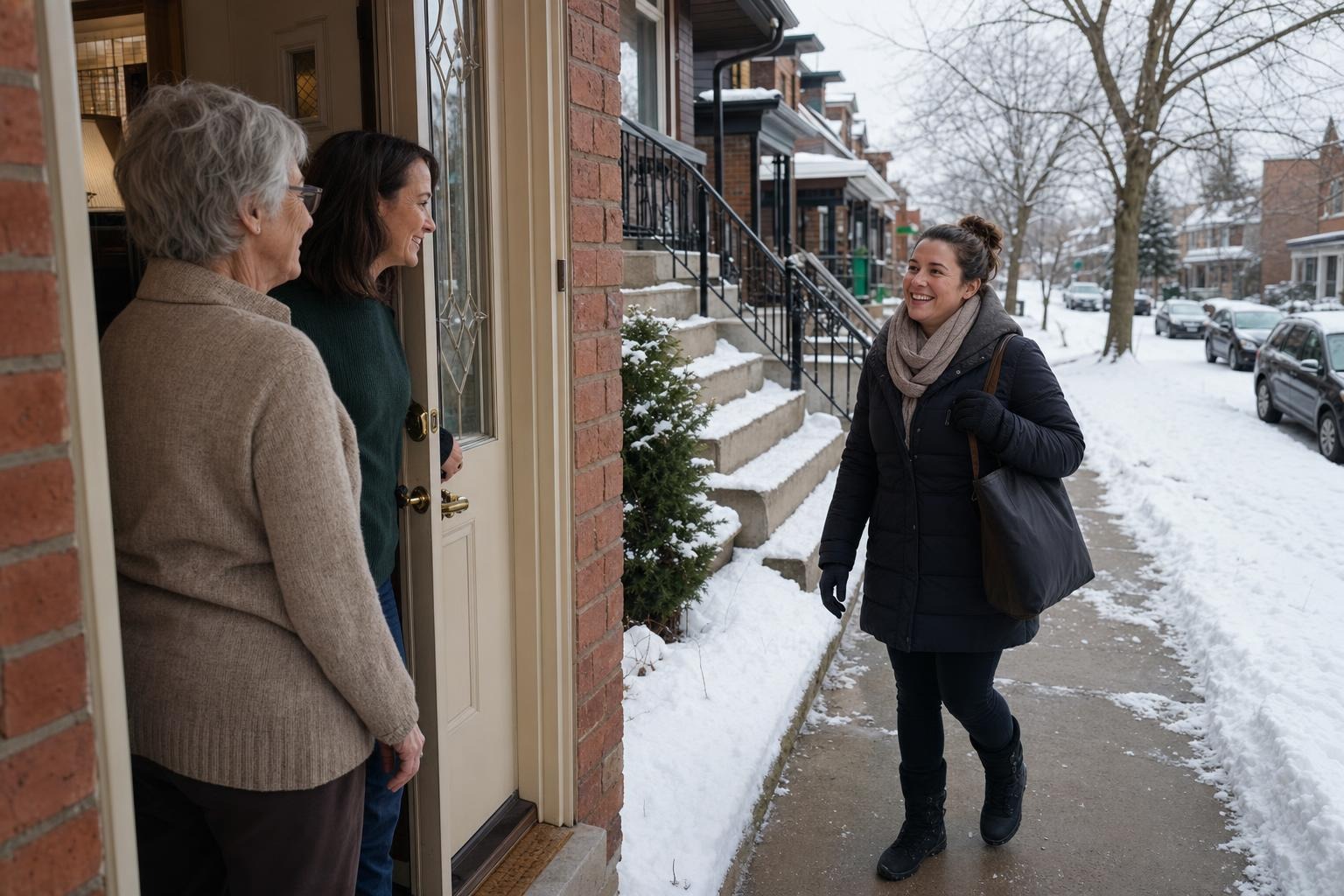
Hamilton is one city, but arranging help can look very different across its neighbourhoods. Geography should not determine the quality of support, yet it does affect timing, access, and what the family needs to communicate.
In an apartment or condominium, consider how a support person will enter the building. Is there a buzzer? Does the older adult need time to reach the lobby? Are there visitor-parking restrictions or concierge procedures? If the elevator is temporarily unavailable, would stairs prevent a scheduled visit from proceeding as expected?
For detached homes, the questions may concern exterior steps, side entrances, long walkways, or where a visitor can park. Winter adds another layer. Snow and ice can affect entrances and travel times, especially when a family’s schedule leaves little room for delays.
Distance within the city matters as well. An adult child in Stoney Creek who regularly helps a parent in Dundas may be able to manage one planned visit but struggle with repeated short-notice trips. A sibling who lives outside Hamilton may be available for decisions yet unable to provide hands-on help. Mapping these realities prevents the family from building a plan around availability that does not truly exist.
Neighbourhood context also includes the older adult’s established life. They may know nearby shopkeepers, attend a place of worship, visit a local community centre, or have neighbours who check in informally. These relationships are valuable, but informal goodwill should not be treated as guaranteed coverage. A neighbour who occasionally brings in a bin is not necessarily available every Tuesday evening.
Record practical access information separately from personal preferences. The first category includes entry procedures, stairs, parking, and contact details. The second includes how the person likes to be addressed, important routines, communication preferences, and parts of the home they consider private. Both affect whether support feels dependable and respectful.
What to ask before arranging support
A useful first conversation should establish scope, expectations, and boundaries. Families do not need to have every detail settled, but they should leave with a clear understanding of what happens next.
Begin with these questions:
- Is the support non-medical? Confirm what falls within the arrangement and what does not. Do not assume that general help at home includes nursing, medical assessment, or clinical treatment.
- Who helps clarify the family’s needs? Some families know exactly what schedule they want. Others need help translating a complicated situation into a practical plan.
- Who is the ongoing point of contact? Ask whom the older adult or family should contact when availability, timing, or needs change.
- How are preferences communicated? Explain important routines, language or communication needs, household boundaries, and the older adult’s priorities.
- What happens when the usual arrangement changes? Ask how schedule changes are discussed and how much notice is expected from each side.
- How are concerns raised? The family should know how to report a problem, ask a question, or request a review.
- What costs and scheduling terms apply? Request clear information before agreeing to an arrangement. Ask about minimum visit lengths, changes, cancellations, and any other terms relevant to the proposed schedule.
Listen for questions as well as answers. A thoughtful conversation should explore the older adult’s routine, what the family is already doing, where the pressure points are, and what a better week would look like. A provider cannot understand a household by hearing only a list of tasks.
Include the older adult directly whenever possible. Adult children may see risks that a parent minimizes, while the parent may have priorities the children overlook. If there is disagreement, separate urgent concerns from preferences. A family can acknowledge a genuine concern without taking control of every daily choice.
Compare coordination models, not just individual tasks
The visible part of home support is the time spent with the older adult. The less visible part is coordination: understanding the situation, arranging support, keeping track of changes, and giving the family a reliable place to ask questions.
Some families are comfortable managing those details themselves. One sibling may handle the calendar, another may communicate changes, and the older adult may be confident explaining preferences directly. This approach can offer substantial family control, but it also creates administrative work. If responsibilities are unclear, messages can be missed or duplicated.
Other families benefit from one knowledgeable point of contact. This can be particularly useful when several relatives are involved, the need is not easy to label, or the family is trying to coordinate help from a distance. The trade-off is that the family must clearly agree on who can make decisions and which updates should be shared.
Vicaria Care’s approved scope is personally arranged, non-medical in-home support, with Hamilton-first service that also includes Burlington, Oakville, and St. Catharines. Its care-concierge approach begins by listening to what would make life at home easier, understanding the need, and helping arrange dependable support. Families considering this model can review the business context on the Vicaria Care website.
Whatever model a family considers, avoid relying on a directory-style comparison alone. A profile or short description cannot show whether the arrangement accounts for the older adult’s routine, the home environment, family availability, and communication expectations. The central question is not simply “Who is available?” It is “How will this arrangement work on an ordinary week and when something changes?”
Build a support plan the family can sustain

A good plan is detailed enough to guide the week but flexible enough to change. Start with the highest-priority periods rather than attempting to solve every future possibility at once.
For example, suppose an older Hamilton resident is generally comfortable in the morning but finds late afternoons difficult. Her daughter visits on Sundays and handles calls during the week, while her son can attend occasional appointments but cannot commit to a regular weekday. The initial plan might focus on predictable late-afternoon support and a clear communication process. It should not assume that either sibling can provide unlimited backup.
Write down five elements:
1. The purpose
State the practical goal in plain language. Examples include making weekday evenings easier, reducing long periods alone, or creating a dependable routine when relatives are at work.
2. The schedule
Identify priority days and times. Note which parts are essential and which have some flexibility. A plan built entirely around vague availability is likely to create confusion.
3. Household preferences
Record the older adult’s usual routine, communication style, privacy expectations, and anything that would help support feel comfortable rather than intrusive.
4. Family roles
Choose one primary family contact where possible. Clarify who handles routine updates, who participates in larger decisions, and who should be contacted if the primary person is unavailable.
5. A review date
Set a point to discuss what is working. The first review might focus on timing, comfort, and communication. Later reviews can consider whether the need has increased, decreased, or shifted to a different part of the week.
Watch for two opposite planning errors. The first is arranging too little because the family is reluctant to acknowledge strain. The second is designing an elaborate schedule before anyone understands what the older adult will accept or use. A focused starting plan, followed by a deliberate review, can reveal more than speculation.
Know when needs belong with the health system
Non-medical support and health care are not interchangeable. If the concern involves clinical assessment, nursing, therapy, treatment, medication questions, or a significant change in health, the family should contact an appropriate regulated health professional or health service.
The Government of Ontario explains publicly funded home and community care, eligibility, and how care coordination works on its home and community care information page. Families can use this resource to understand the public system rather than assuming a non-medical arrangement covers clinical needs.
When speaking with any home-support organization, describe the situation accurately and ask whether the request fits its scope. Do not soften or omit health concerns simply to secure an arrangement. Clear boundaries protect the older adult and help everyone understand which needs require a different source of care.
A family may use more than one type of support, provided roles are clear. The important point is to avoid leaving clinical responsibilities in a non-medical plan or assuming that one contact replaces the appropriate health-care team.
Frequently asked questions
How early should a family begin looking for home support?
Begin when a recurring gap appears, not only after a crisis. Repeated scheduling conflicts, growing isolation, or a family caregiver’s declining capacity are reasonable signals to explore options. Early conversations allow more time to understand preferences and compare arrangements without making rushed decisions.
Should every sibling be involved in the first conversation?
Not necessarily. Too many voices can overwhelm the older adult and complicate routine decisions. It is often more practical to choose one or two participants, gather input from others beforehand, and identify a primary family contact. The older adult should remain central to the conversation whenever possible.
Does living alone automatically mean someone needs daily support?
No. Living arrangements alone do not define the need. Consider the person’s routines, confidence, social connections, home environment, family availability, and any concerns that should be assessed by a health professional. Some people need help at specific times rather than every day.
What if an older parent refuses help?
Ask what feels objectionable. The concern may be loss of privacy, fear of being controlled, uncertainty about the person entering the home, or disagreement about what is needed. Discuss one concrete pressure point and propose a limited, reviewable arrangement rather than presenting a complete plan as a settled decision.
Can one plan cover relatives living in different cities?
Each household needs its own assessment and arrangement. A family coordinating support for relatives in Hamilton, Burlington, Oakville, or St. Catharines should account for each person’s routine, home, local contacts, and family availability rather than copying the same schedule across locations.
Next steps for choosing support
Bring the family’s observations together on one page: the difficult times of the week, the older adult’s priorities, the help relatives can reliably provide, neighbourhood access details, and any needs that belong with a health professional. Then use that information to have a focused conversation about non-medical support.
The strongest plan is not necessarily the largest one. It is the arrangement that addresses a real need, respects the older adult’s home and choices, gives the family clear responsibilities, and can be reviewed as life changes.